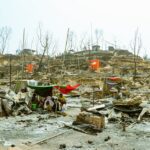
**BREAKING: Japan declared a national emergency at 11:47 PM JST after an 8.2 magnitude earthquake struck central Tokyo, causing widespread structural collapse and triggering a massive international rescue response. The quake, centered 12 kilometers beneath Shibuya district, represents the strongest seismic event to hit Japan’s capital since records began in 1885.**
Prime Minister Yoshihide Suga announced the emergency declaration from an underground bunker in Nagatacho, stating that preliminary damage assessments indicate “catastrophic infrastructure failure across multiple Tokyo wards.” The Tokyo Metropolitan Government reports at least 847 confirmed casualties within the first six hours, with thousands more trapped in collapsed buildings throughout the metropolitan area.
The earthquake struck during peak evening hours, maximizing human exposure as millions of residents were commuting home or dining in the city’s dense commercial districts. Japan’s advanced early warning system provided only 8 seconds of notice—insufficient time for meaningful protective action given the quake’s proximity and intensity.

## Unprecedented Scale of Destruction Overwhelms Tokyo’s Infrastructure
The 8.2 magnitude quake has caused systematic failure across Tokyo’s critical infrastructure networks. Tokyo Electric Power Company (TEPCO) reports complete power grid collapse affecting 13.7 million residents across Greater Tokyo, with backup systems failing at 67% of emergency facilities. The Yamanote Line, Tokyo’s primary rail artery, suffered track buckling at 23 locations, while Narita and Haneda airports suspended all operations after runway fractures rendered them inoperable.
Tokyo’s famed earthquake-resistant building codes, updated following the 2011 Tōhoku disaster, proved insufficient against the unprecedented ground acceleration. The 54-story Roppongi Hills Mori Tower developed a 15-degree tilt, forcing emergency evacuation of 3,200 occupants. Similarly, the Tokyo Skytree’s observation decks cracked at multiple points, though the main structure remains intact.
### Critical Infrastructure Failures Mount
Water distribution networks across five Tokyo wards have completely failed, leaving 2.3 million residents without access to clean water. Tokyo Waterworks Bureau Chief Engineer Hiroshi Tanaka confirmed that main distribution pipes beneath central Tokyo “experienced catastrophic rupture due to soil liquefaction in reclaimed bay areas.”
The Tokyo Stock Exchange trading floor suffered severe structural damage, forcing indefinite closure and triggering a global financial market selloff. Bank of Japan Governor Kazuo Ueda announced emergency liquidity measures totaling ¥15 trillion ($98 billion USD) to prevent systemic financial collapse as international markets opened across Asian time zones.
## International Rescue Operations Launch Within Hours
The United States activated its Forward Deployed Emergency Response Team (FDERT) from Yokota Air Base at 12:23 AM JST, deploying 340 specialized rescue personnel with heavy extraction equipment. US Ambassador to Japan Rahm Emanuel confirmed that two C-130 aircraft carrying Urban Search and Rescue teams departed from California bases within three hours of the initial quake.
South Korea dispatched its 119 Rescue Service elite team aboard military transport aircraft, marking the fastest international disaster response in the region’s history. The 89-member Korean team brings specialized concrete-cutting equipment and thermal imaging technology specifically designed for high-density urban collapse scenarios.
### Coordinated Global Response Emerges
China announced deployment of its National Earthquake Disaster Emergency Rescue Team, despite ongoing territorial tensions in the East China Sea. The 420-person Chinese contingent includes medical specialists and heavy machinery operators trained in mega-city disaster scenarios. This represents the largest Chinese disaster relief deployment to Japan since diplomatic relations normalized in 1972.
The European Union activated its Civil Protection Mechanism at 3:15 AM local time, with specialized teams from Germany, France, and the Netherlands preparing for immediate deployment. EU Crisis Management Commissioner Janez Lenarčič stated that European teams would focus on medical evacuation and water purification systems.

## Technological Systems Prove Both Vulnerable and Essential
Japan’s vaunted disaster preparedness technology showed mixed results under extreme conditions. The nationwide J-Alert emergency broadcast system functioned perfectly, delivering earthquake warnings to 127 million mobile devices within 12 seconds. However, the system’s effectiveness was limited by the quake’s proximity and intensity, providing insufficient warning time for meaningful protective action.
Emergency communication networks experienced partial failure as cellular towers collapsed or lost power backup. NTT Docomo reported 34% network capacity loss across Greater Tokyo, while SoftBank maintained 78% functionality through its distributed micro-cell architecture implemented after 2011 lessons learned.
### Digital Infrastructure Maintains Critical Functions
Tokyo’s smart city sensor network, installed progressively since 2019, provided real-time damage assessment data to emergency responders. The 15,000-sensor network automatically transmitted structural integrity data from major buildings, allowing rescue teams to prioritize high-risk locations immediately. This technology enabled rescue coordination that would have taken days to achieve through traditional assessment methods.
Social media platforms became essential communication tools as traditional networks failed. Line messaging app usage surged 340% as residents coordinated family safety checks and shared real-time ground conditions. Twitter’s emergency broadcast partnership with Tokyo Metropolitan Government enabled authorities to provide location-specific safety instructions despite infrastructure failures.

## Economic and Social Implications Ripple Globally
Tokyo Stock Exchange closure triggered immediate global market reactions, with Nikkei futures plunging 12% in overnight trading on Chicago Mercantile Exchange. Insurance industry analysts project total economic losses exceeding $280 billion, potentially ranking as the costliest natural disaster in recorded history. Lloyd’s of London activated its catastrophe response protocols, mobilizing assessment teams for what industry executives call “a generation-defining event.”
Supply chain disruptions emanating from Tokyo’s port facilities immediately affected global manufacturing. Toyota Motor announced indefinite suspension of operations at 14 domestic plants, while Sony halted production at its Kumamoto semiconductor facility as a precautionary measure. These shutdowns will likely trigger parts shortages affecting automotive and electronics industries worldwide within 72 hours.
### Long-term Recovery Timeline Emerges
Japanese government officials estimate primary infrastructure restoration will require 18-24 months, based on 2011 Tōhoku recovery timelines adjusted for urban complexity. However, Tokyo’s significantly higher building density and infrastructure interconnectedness may extend recovery periods beyond historical precedents.
The disaster highlights critical vulnerabilities in megacity disaster preparedness despite Japan’s world-leading earthquake engineering. Tokyo’s 37 million metropolitan area residents represent the largest concentration of earthquake-exposed population globally, making this event a crucial test case for urban disaster resilience.
**The immediate priority remains search and rescue operations, with international teams expected to maintain active operations for at least two weeks. Japanese authorities emphasize that casualty numbers will likely increase significantly as rescue teams access collapsed structures throughout Tokyo’s dense urban core. This disaster will fundamentally reshape global approaches to megacity earthquake preparedness and international disaster response coordination.**