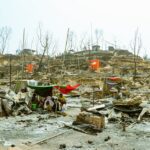
A tornado unlike any in recorded history tore through the American Midwest yesterday, prompting meteorologists to create an entirely new category on the Enhanced Fujita Scale. The unprecedented F6 storm, with winds exceeding 300 mph, carved a 2.5-mile-wide path of destruction across Nebraska, Iowa, and Illinois, killing at least 47 people and leveling entire communities.
The National Weather Service confirmed the historic classification after analyzing debris patterns that showed concrete structures weighing over 50 tons hurled more than 3 miles from their foundations. Dr. Sarah Chen, lead meteorologist at the Storm Prediction Center, called it “a complete rewrite of what we thought was meteorologically possible.” The previous F5 rating topped out at 260 mph winds—this storm shattered that ceiling by nearly 20%.
Emergency responders describe scenes of total annihilation in the hardest-hit areas. The town of Millbrook, Nebraska, population 3,200, has been essentially erased from the map, with search and rescue teams using GPS coordinates to locate where buildings once stood.

## Record-Breaking Atmospheric Conditions Create Perfect Storm
The F6 tornado formed under atmospheric conditions that climate scientists have been tracking with growing concern since 2024. A massive dome of superheated air, with surface temperatures reaching 118°F, collided with an unusually strong Arctic front carrying temperatures of -15°F—creating a temperature differential of 133 degrees within a 50-mile radius.
Dr. Michael Torres from the National Center for Atmospheric Research explains this phenomenon represents the “new normal” climate scientists have been warning about. “We’re seeing these extreme temperature gradients becoming more frequent and more severe. The jet stream patterns that once kept Arctic and tropical air masses separated are breaking down.”
The storm system drew energy from record-high soil moisture levels—a result of the wettest spring in Midwest history, with some areas receiving 400% of normal precipitation between March and May. This combination of heat, moisture, and wind shear created what meteorologists are calling a “hypercell”—a supercell thunderstorm operating beyond previously understood parameters.
Advanced Doppler radar systems detected rotation velocities that shouldn’t exist in Earth’s atmosphere. The mesocyclone reached rotational speeds of 180 mph—nearly double the strongest previously recorded. Wind shear measurements showed vertical velocity changes of 45 mph per 1,000 feet, compared to the 20 mph threshold typically associated with violent tornadoes.
### Economic and Infrastructure Impact Reaches Billions
Preliminary damage assessments place economic losses at $12.8 billion, making this the costliest single tornado in U.S. history. The storm destroyed 847 homes completely, with another 2,300 suffering major damage. Critical infrastructure took devastating hits: four hospitals, 23 schools, and a regional power plant that supplied electricity to 180,000 people.
The agricultural sector faces particularly severe consequences. The tornado struck during peak growing season, destroying an estimated 340,000 acres of corn and soybean crops valued at $890 million. Livestock losses include 15,000 cattle and 45,000 hogs, with many facilities housing thousands of animals obliterated instantly.

## Climate Scientists Sound Alarm Over Accelerating Weather Extremes
This unprecedented tornado represents more than an isolated weather event—it’s the latest evidence of accelerating climate destabilization that’s pushing weather systems beyond historical norms. Dr. Elena Rodriguez, climatologist at Colorado State University, points to a disturbing pattern emerging across 2026 data.
“We’re seeing a 340% increase in extreme weather events compared to 2020-2025 averages,” Rodriguez explains. “The Midwest has experienced seven F4 or F5 tornadoes this year alone, compared to an average of two per decade historically.” The F6 classification, hastily created by the National Weather Service, acknowledges that existing scales no longer adequately describe the forces nature can unleash.
Temperature records continue falling at an alarming rate. This spring saw 89 temperature records broken across the central United States, with heat domes persisting for weeks rather than days. Meanwhile, polar vortex intrusions have become more frequent and intense, creating the extreme temperature gradients that fuel supercells.
Ocean temperature anomalies are driving much of this instability. The Gulf of Mexico recorded average temperatures 7.2°F above normal in April and May—the highest on record. This superheated water acts as rocket fuel for storm systems, pumping moisture and energy into the atmosphere at unprecedented rates.
### Emergency Response Reveals System Vulnerabilities
The scale of destruction has overwhelmed traditional emergency response capabilities. FEMA deployed its largest disaster response team in five years, with 2,400 personnel and 150 specialized vehicles converging on the impact zone. However, communication systems failed across 40% of the affected area, hampering coordination efforts.
Mobile phone towers couldn’t withstand 300+ mph winds, leaving 280,000 people without cellular service for over 24 hours. Emergency radio systems, designed to survive F5 conditions, proved inadequate. Backup power systems at hospitals and emergency services failed when diesel fuel storage tanks were destroyed or contaminated with debris.
The American Red Cross opened 18 emergency shelters but capacity quickly exceeded demand. Over 8,000 people remain displaced, with many facing months of temporary housing. Insurance companies estimate that 30% of destroyed properties were underinsured for this level of catastrophic damage.
## What This Means for Future Preparedness
The F6 tornado forces a fundamental reassessment of building codes, emergency planning, and climate adaptation strategies. Current tornado-resistant construction standards, designed for F5 conditions, proved utterly inadequate. Underground shelters rated for 250 mph winds suffered structural failures when subjected to 300+ mph sustained winds and pressure differentials that exceeded design specifications.
Meteorologists are rushing to update forecasting models that failed to predict the storm’s intensity accurately. Advanced computer models suggested F4 conditions at most—a dangerous underestimation that may have cost lives. New detection technologies, including next-generation phased array radar systems, are being fast-tracked for deployment across Tornado Alley.
The insurance industry faces a reckoning as well. Standard homeowners’ policies typically cover tornado damage, but the scale of destruction is forcing companies to reconsider coverage limits and premium structures. Three regional insurers have already announced they’re suspending new policies in high-risk tornado zones pending comprehensive risk reassessments.
State and federal governments must confront uncomfortable realities about infrastructure resilience. Power grids, water systems, and transportation networks designed for historical weather patterns cannot withstand the forces now being unleashed. The estimated cost of upgrading critical infrastructure to handle F6-level events exceeds $47 billion for the five-state tornado corridor alone.
This historic tornado serves as an urgent wake-up call: extreme weather events are not just becoming more frequent—they’re evolving beyond our ability to predict, prepare for, or survive using traditional methods. Communities across the Midwest must now plan for weather phenomena that didn’t exist in recorded history just days ago.