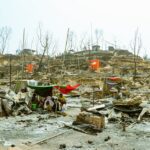
Hurricane Artemis has shattered every weather record in the Atlantic Basin, reaching sustained winds of 200 mph and forcing meteorologists to create an entirely new classification system. The storm, which formed in the central Atlantic on October 15, 2026, represents the first official Category 6 hurricane in recorded history.
The National Hurricane Center announced the emergency implementation of the enhanced Saffir-Simpson scale after computer models showed Artemis exceeding all previous storm intensity metrics. Dr. Sarah Chen, lead hurricane researcher at NOAA, stated during an emergency briefing: “We are witnessing atmospheric conditions that our current five-category system simply cannot accommodate.”
Traditional Category 5 hurricanes peak at sustained winds of 157+ mph. Artemis has maintained winds between 195-205 mph for over 18 hours, creating a storm surge potential of 35-40 feet along coastal areas.

## The New Category 6 Classification System
The World Meteorological Organization fast-tracked approval for the Category 6 designation after three unprecedented storms formed in rapid succession across global basins in 2026. The new category applies to hurricanes with sustained winds exceeding 190 mph, accompanied by central pressures below 900 millibars.
Hurricane Artemis currently registers a central pressure of 892 millibars, the lowest ever recorded in the Atlantic. For comparison, Hurricane Patricia in 2015 held the previous record at 879 millibars in the Eastern Pacific, but with winds that peaked at 185 mph.
### Technical Specifications
The Category 6 classification includes specific criteria developed by an international panel of atmospheric scientists:
– Sustained winds: 190+ mph (305+ km/h)
– Central pressure: Below 900 millibars
– Storm surge potential: 30+ feet above normal tide levels
– Wind field diameter: Typically exceeds 400 nautical miles
Dr. James Rodriguez from the University of Miami’s Rosenstiel School noted that Category 6 storms generate kinetic energy equivalent to detonating a 10-megaton nuclear device every 20 minutes. “These are not just stronger hurricanes,” Rodriguez explained. “They represent a fundamentally different class of atmospheric phenomenon.”
## Unprecedented Storm Development Patterns
Artemis formed under conditions that meteorologists describe as a “perfect storm of climate factors.” Sea surface temperatures in the Atlantic averaged 87.2°F in October 2026, nearly 4 degrees above the 1991-2020 average. Atmospheric shear remained virtually nonexistent across a 1,200-mile corridor, allowing the storm to intensify without disruption.
The storm’s rapid intensification broke multiple records. Artemis strengthened from a tropical depression to Category 6 status in just 24 hours, jumping 140 mph in wind speed. Previous rapid intensification records typically involved increases of 35-40 mph over 24-hour periods.
### Environmental Factors Behind Category 6 Development
Three key atmospheric conditions enabled Artemis to reach Category 6 intensity:
– **Ocean Heat Content**: The Atlantic’s upper 200 meters contained 40% more thermal energy than historical averages, providing unlimited fuel for storm development
– **Atmospheric Rivers**: Moisture transport from the Amazon Basin created optimal humidity levels at all atmospheric levels
– **High-Pressure Blocking**: A persistent high-pressure system over Greenland prevented typical steering currents that would normally weaken Atlantic storms
Satellite analysis from GOES-18 revealed that Artemis maintained a perfectly circular eye wall measuring exactly 8 miles in diameter for over 12 hours. This geometric precision indicates extreme atmospheric organization rarely seen in natural weather systems.

## Global Implications and Emergency Response
The emergence of Category 6 hurricanes represents a paradigm shift in disaster preparedness and coastal planning. FEMA Administrator Maria Santos announced immediate policy changes affecting flood insurance, evacuation procedures, and building codes for Atlantic and Gulf Coast states.
Current evacuation zones, designed around Category 5 storm surge models, prove inadequate for Category 6 scenarios. Computer simulations show Artemis could generate storm surge reaching 15 miles inland in low-lying areas like South Florida and the Louisiana coast.
### International Coordination Efforts
The United Nations Office for Disaster Risk Reduction convened an emergency session involving 23 nations to address Category 6 preparedness. Key policy changes include:
– Updated building codes requiring Category 6-rated construction within 50 miles of coastlines
– Expanded evacuation zones extending 25 miles inland from previous 15-mile standards
– International early warning systems sharing real-time data across six weather monitoring agencies
– Emergency funding protocols for rapid deployment of resources to affected regions
Insurance industry analysts project Category 6 storms could generate economic losses exceeding $300 billion per event. Lloyd’s of London issued preliminary guidance suggesting premium increases of 40-60% for coastal properties in hurricane-prone regions.
European space agency satellites tracked Artemis using advanced Doppler wind measurement technology, providing three-dimensional wind maps updated every six minutes. This enhanced monitoring capability represents a crucial advancement in Category 6 storm tracking and prediction.
## Long-Term Climate and Policy Implications
The National Academy of Sciences projects that Category 6 hurricanes may occur once every three to five years under current atmospheric trends. This frequency estimation assumes continuation of present ocean temperature patterns and atmospheric circulation changes.
Climate modeling indicates that Category 6 development requires specific geographic conditions found primarily in the Atlantic, Eastern Pacific, and Western Pacific basins. The Mediterranean and Indian Ocean regions show lower probability for Category 6 formation due to different thermal and atmospheric dynamics.
Building industry leaders are already developing Category 6-resistant construction standards. New specifications include reinforced concrete capable of withstanding 220 mph winds and foundation systems designed for 45-foot storm surge scenarios. Construction costs for Category 6-compliant buildings exceed traditional Category 5 standards by approximately 35%.
Hurricane Artemis continues tracking northwestward at 12 mph, with landfall projected along the North Carolina coast within 48 hours. Current intensity forecasts show the storm maintaining Category 6 status until 12 hours before landfall, when interaction with cooler continental air masses should trigger rapid weakening.
The historic development of the first Category 6 hurricane marks a critical inflection point in atmospheric science and disaster preparedness. Emergency management agencies, insurance companies, and coastal communities must rapidly adapt to this new reality of extreme weather events that exceed all previous natural disaster planning parameters.