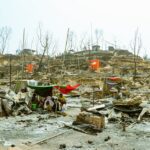
South Africa’s Western Cape government issued an unprecedented evacuation order for Cape Town’s 4.7 million residents as the city’s water reserves dropped to just 3% capacity. The announcement, made at 6 AM local time on March 15, 2026, marks the first time any government has declared a climate refugee emergency due to water scarcity.
President Cyril Ramaphosa’s administration activated Emergency Protocol 7, granting temporary refugee status to all Cape Town residents and authorizing immediate relocation to inland cities. “We cannot wait for Day Zero anymore,” said Western Cape Premier Alan Winde during the emergency broadcast. “Day Zero is today.”
The crisis escalated when the Theewaterskloof Dam, Cape Town’s primary water source, registered its lowest level in recorded history at 2.8% capacity. Combined with a five-year drought and groundwater depletion rates of 15 centimeters annually, the city faces complete water system collapse within 72 hours.

Mass Relocation Triggers Continental Response
The South African National Defence Force deployed 12,000 personnel to coordinate the largest peacetime evacuation in African history. Military transport aircraft from Waterkloof Air Force Base began shuttling residents to temporary camps in Johannesburg, Pretoria, and Durban at 15-minute intervals.
Johannesburg Mayor Mpho Phalatse announced the city would accommodate 800,000 Cape Town refugees in converted stadiums, convention centers, and unused office buildings. The OR Tambo International Airport suspended commercial flights to prioritize evacuation operations, with South African Airways repurposing its entire domestic fleet.
“We’re looking at housing costs of R2.3 billion per month just for basic accommodation,” said Finance Minister Enoch Godongwana during an emergency parliamentary session. The African Union pledged R5 billion in emergency funding, while Nigeria, Kenya, and Ghana offered to accept 50,000 refugees each.
International water relief organizations mobilized rapidly. The Red Cross deployed 200 water purification units capable of processing 500,000 liters daily, while Israel’s Mekorot water company airlifted five emergency desalination units from Tel Aviv.
Infrastructure Collapse Accelerates Timeline
Cape Town’s water infrastructure began failing systematically as reservoir levels dropped below operational thresholds. The Steenbras pumping station shut down on March 14 when intake pipes drew only air and sediment. Municipal officials confirmed that 67% of the city’s water treatment facilities stopped operating within 24 hours.
Hospital evacuations commenced when Groote Schuur Hospital’s water reserves fell to six hours of capacity. Medical helicopter services transferred 340 critical patients to facilities in Port Elizabeth and Bloemfontein. Private healthcare groups Netcare and Mediclinic activated their national emergency protocols, redistributing equipment and staff across the country.

The Port of Cape Town suspended operations after tugboat and firefighting systems couldn’t maintain minimum water pressure. Shipping companies rerouted 47 vessels to Durban and Port Elizabeth, creating a logistics bottleneck affecting R12 billion in monthly trade volume.
Agricultural impacts spread beyond the immediate evacuation zone. Wine estates in Stellenbosch and Paarl began emergency harvesting procedures, attempting to salvage R9.2 billion worth of grape crops before complete abandonment. The South African Wine Industry Information & Systems reported that 340 wineries face permanent closure.
Climate Refugee Framework Sets Global Precedent
South Africa’s climate refugee designation represents the first official recognition of water-driven displacement under international law. The United Nations High Commissioner for Refugees fast-tracked approval for a new classification system, potentially affecting 1.2 billion people in water-stressed regions globally.
Legal experts predict the Cape Town precedent will influence pending cases in Chennai (population 7 million), which experienced complete reservoir depletion in 2019, and São Paulo (12 million), where water reserves reached critical levels in 2021 and again in 2025.
“This changes everything about how we approach climate migration,” said Dr. Koko Warner, head of the UN’s Climate Change and Migration unit. “Cape Town just made climate refugees legally recognized instead of statistically invisible.”

The European Union expedited its Climate Migration Compact, originally scheduled for 2028 implementation. EU Commissioner for Migration Ylva Johansson announced that Cape Town residents would receive priority processing for climate asylum applications, with streamlined 30-day approval procedures.
Australia’s Department of Home Affairs created a new visa category specifically for climate-displaced persons, while Canada increased its climate refugee quota from 2,000 to 25,000 annually. New Zealand extended its Pacific Climate Visa program to include African applicants for the first time.
Economic Ripple Effects Destabilize Regional Markets
The Johannesburg Stock Exchange suspended trading for Cape Town-based companies after share prices collapsed by an average of 43% in pre-market trading. Naspers, South Africa’s largest company by market capitalization, announced temporary headquarters relocation to Johannesburg, affecting 8,700 employees.
Mining giant Anglo American activated contingency plans to relocate its Cape Town operations to Perth, Australia, citing long-term water security concerns. The company’s R24 billion platinum and diamond operations employ 15,400 workers in the Western Cape region.
Tourism losses reached immediate crisis levels as international airlines canceled flights and cruise ships avoided Cape Town ports. The South African Tourism Board estimated R18 billion in lost revenue for 2026, with 340,000 tourism jobs at immediate risk.
Long-term Solutions Emerge from Crisis
The South African government fast-tracked R45 billion in desalination infrastructure, contracting Israeli firm IDE Technologies to build six plants capable of producing 450 million liters daily. Construction timelines compressed from typical 5-year projects to 18-month emergency builds using prefabricated modules.
Atmospheric water generation technology gained unprecedented government support. California-based Zero Mass Water received a R2.8 billion contract to install 50,000 solar-powered water panels across relocated communities. Each panel produces 10 liters daily, requiring no existing water infrastructure.
The crisis accelerated South Africa’s renewable energy transition. Solar panel installations increased 340% in March 2026 alone as evacuated residents sought energy independence in their new locations. The government’s emergency energy program allocated R12 billion for distributed solar systems in refugee accommodation centers.
Cape Town’s evacuation marks a watershed moment in climate adaptation. Other water-stressed cities now face a stark choice: invest massively in water security infrastructure or prepare for similar mass relocations. The South African model provides both a warning and a framework for managing climate-driven displacement at unprecedented scales.
The immediate priority remains relocating 4.7 million people safely while maintaining social cohesion and economic stability. Success will determine whether Cape Town’s refugees eventually return home or whether this evacuation becomes permanent—setting the template for climate migration in the decades ahead.