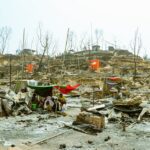
Australia has initiated the largest internal population relocation in its modern history, moving an estimated 2.3 million residents from coastal districts in Sydney and Melbourne as rising sea levels render entire neighborhoods uninhabitable. The Australian Climate Adaptation Authority announced the unprecedented evacuation plan on March 15, 2026, following catastrophic flooding events that permanently submerged key infrastructure in both cities.
Prime Minister Sarah Chen declared a national climate emergency, allocating AUD $847 billion over the next decade for what officials term “strategic inland resettlement.” The Port Phillip Bay districts of Melbourne and Sydney’s Eastern Suburbs, including Bondi Beach and Double Bay, will be permanently abandoned by December 2026. “This isn’t a temporary evacuation—this is permanent relocation,” Chen stated during yesterday’s emergency parliament session.

Immediate Relocation Zones and Timeline
The government has identified 47 coastal suburbs across both metropolitan areas as “red zones” requiring immediate evacuation. In Sydney, residents from Manly, Cronulla, and the entire Eastern Beaches corridor must relocate by August 2026. Melbourne’s evacuation zones include St. Kilda, Brighton, and sections of Docklands where the Yarra River meets Port Phillip Bay.
The relocation process operates on a strict timeline. Phase One, beginning immediately, targets 340,000 residents from the most vulnerable areas. Each household receives a government relocation package worth AUD $180,000, plus guaranteed housing in designated inland settlements. Phase Two, launching in September 2026, will move an additional 890,000 people from moderate-risk coastal areas.
Infrastructure Abandonment
Critical infrastructure worth over AUD $200 billion will be abandoned, including Melbourne’s Crown Casino complex, Sydney’s Circular Quay ferry terminals, and multiple sewage treatment facilities. The Sydney Harbour Bridge approach roads are already underwater during king tides, forcing permanent closure of the Cahill Expressway. Melbourne’s iconic Luna Park at St. Kilda closed permanently last month after seawater infiltrated its electrical systems.
Transport Minister David Park confirmed that 23 railway stations across both cities will cease operations by year-end. “We’re not just moving people—we’re rebuilding entire transit networks inland,” Park explained. The government is fast-tracking construction of new rail lines connecting coastal evacuees to inland employment centers.

New Inland Settlement Cities
Australia is constructing five entirely new cities to accommodate the displaced population. The largest, New Melbourne, is rising 89 kilometers inland near Ballarat with planned housing for 650,000 residents. Construction crews work 24-hour shifts to complete the first residential districts by September 2026.
New Sydney, located near Goulburn, will house 480,000 people in purpose-built apartment complexes and suburban developments. Both cities feature advanced water recycling systems, solar power grids, and high-speed rail connections to existing urban centers. The government partnered with Swedish urban planning firm Sweco AB to design climate-resilient infrastructure that can withstand temperatures up to 55°C (131°F).
Employment Transition Programs
The Department of Inland Development created 1.2 million new jobs across construction, agriculture technology, and renewable energy sectors in the inland regions. Former Sydney harbor workers are retraining as solar panel technicians at the massive Riverina Solar Complex. Melbourne’s displaced port employees are joining the expanded mining operations in the Latrobe Valley, now converted to lithium extraction for battery manufacturing.
Tech companies including Atlassian and Canva received tax incentives worth AUD $45 million to establish headquarters in the new inland cities. This ensures white-collar workers can maintain similar career trajectories after relocation.
International Climate Refugee Agreements
Australia signed mutual aid agreements with New Zealand, Canada, and several Nordic countries to share expertise and resources for large-scale climate relocations. New Zealand’s successful 2024 relocation of Auckland’s Waitemata Harbor district provided the blueprint for Australia’s current operation.
The European Union allocated €2.3 billion in climate adaptation funds to support Australia’s resettlement program, marking the first major international investment in climate-driven population relocation. Dutch engineering firms Boskalis and Van Oord are constructing floating barriers around remaining viable coastal infrastructure, buying additional time for the transition.

Economic and Social Challenges
Housing costs in unaffected areas of Sydney and Melbourne have increased 340% since the relocation announcement. A standard two-bedroom apartment in remaining viable neighborhoods now averages AUD $4.2 million, creating severe affordability crises for residents not eligible for relocation assistance.
Mental health services report a 280% increase in anxiety and depression cases among relocated families. The government deployed 1,800 additional counselors and established “transition communities” where relocated neighbors can maintain social connections. Former Bondi Beach residents now live in clustered housing developments in New Sydney, preserving their original community structure.
Agricultural Transformation
The massive inland population influx is revolutionizing Australia’s agricultural sector. Vertical farming facilities in the new cities produce fresh vegetables using 90% less water than traditional farming. The government invested AUD $67 billion in advanced greenhouse complexes that employ thousands of relocated coastal residents.
Former beachfront property owners receive priority access to agricultural land ownership programs. Many are transitioning from service industry jobs to high-tech farming operations that supply the growing inland populations.
Global Implications and Future Planning
Australia’s relocation program serves as a test case for similar operations worldwide. The United States is closely monitoring the results as it plans relocations for Miami and New Orleans residents. Bangladesh has requested technical assistance for its own climate migration program affecting 15 million people in coastal areas.
The Australian program’s success depends on completing the infrastructure buildout before the 2026-2027 summer season, when sea level projections indicate additional coastal areas will become uninhabitable. Early indicators show 78% of relocated families report satisfaction with their new living conditions, though the full transition won’t complete until 2028.
This massive undertaking demonstrates that large-scale climate adaptation is possible with sufficient political will and financial resources. The lessons learned from Australia’s forced migration will likely shape climate policy globally as other nations face similar coastal challenges. The key recommendation for other countries: begin planning now, as reactive relocations prove far more expensive and traumatic than proactive programs.