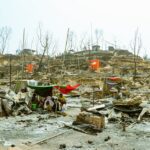
The largest human migration in modern African history is unfolding as persistent drought forces 15 million people to abandon their homes across Sub-Saharan Africa. This mass exodus, unprecedented since the 1984-85 famine, has triggered emergency responses from international organizations and forced a complete rethinking of climate adaptation strategies.
The scale of displacement dwarfs previous climate-induced migrations. In Chad alone, 3.2 million people have left their traditional farming communities in the past eight months. Mali reports 2.8 million internal refugees, while Niger struggles with 2.1 million displaced persons overwhelming urban centers. The UN estimates the total could reach 20 million by year’s end if conditions don’t improve.

## Crisis Spreads Across Sahel Region as Traditional Coping Mechanisms Fail
The drought, now in its fourth consecutive year, has devastated the Sahel’s agricultural backbone. Lake Chad has shrunk to just 15% of its original size, eliminating fishing livelihoods for 2.5 million people who depended on its waters. In Burkina Faso, millet and sorghum yields have dropped 78% below normal levels, forcing entire villages to migrate southward toward coastal nations.
Traditional seasonal migration patterns have collapsed under the severity of conditions. Fulani herders, who historically moved cattle in predictable cycles, now travel unprecedented distances seeking pasture. Amadou Diallo, a herder from northern Mali, walked 400 kilometers with his remaining 12 cattle—down from 150 head three years ago—before reaching refugee camps in Bamako.
Urban areas struggle to absorb the influx. Ouagadougou, Burkina Faso’s capital, has seen its population swell by 35% since January 2026. Informal settlements have tripled in size around major cities, creating humanitarian challenges that local governments cannot address. Water shortages, already critical in drought-affected regions, worsen as displaced populations concentrate in areas with limited infrastructure.
The economic impact extends beyond agriculture. Mining operations in Mali and Niger have suspended activities as workers abandon remote sites. Cross-border trade, vital for landlocked nations, has plummeted 60% as traditional routes become impassable due to security concerns and resource competition.
## International Response Mobilizes as UN Convenes Emergency Climate Summit
UN Secretary-General António Guterres announced an emergency climate summit scheduled for March 15-17, 2026, in Geneva. The gathering will focus specifically on climate-induced migration, with Sub-Saharan Africa as the primary case study. Representatives from 54 African nations, major donor countries, and climate organizations will participate.
The World Food Programme has launched its largest African operation since 1985, requiring $2.8 billion in funding. Emergency food distributions reach 8.5 million people weekly across seven countries, but WFP Executive Director Cindy McCain warns that resources remain insufficient. “We need sustained funding for at least 18 months to prevent complete societal breakdown,” McCain stated during a February briefing.
European Union response has been complicated by migration concerns. While the EU pledged €800 million in emergency aid, internal discussions reveal deep divisions about accepting climate refugees. France has increased border security along Mediterranean routes, anticipating secondary migration from North Africa as displaced Sub-Saharan populations move northward.
The African Union has activated its Continental Early Warning System, coordinating resource sharing among member states. Ghana, Côte d’Ivoire, and Nigeria have opened corridors for temporary relocation, though their own resources strain under the pressure. Ghana’s government estimates hosting 400,000 refugees will cost $180 million annually.

## Regional Stability Threats Emerge as Competition for Resources Intensifies
Armed conflicts have erupted in multiple locations as displaced populations compete for scarce resources. In northern Nigeria, clashes between farmers and herders have killed over 1,200 people since December 2025. Similar tensions escalate across the Chad-Cameroon border, where water access disputes have triggered violence in 15 communities.
The security implications extend beyond local conflicts. Intelligence agencies report increased recruitment by extremist groups who exploit displaced populations’ desperation. Boko Haram and affiliated organizations have gained 30% more fighters in the past year, primarily from drought-affected areas where traditional governance structures have collapsed.
Border controls have tightened across the region despite ECOWAS free movement protocols. Senegal implemented emergency visa requirements for inland migrants, while Cameroon deployed additional troops along its northern frontier. These restrictions create bottlenecks that worsen humanitarian conditions and increase smuggling activities.
International observers warn that current displacement patterns could reshape regional demographics permanently. The International Organization for Migration projects that 40% of displaced persons will never return to their origin communities, even if rains resume. This represents a fundamental shift in Sub-Saharan Africa’s demographic distribution, concentrating populations in southern and coastal areas while depopulating traditional agricultural regions.
## Long-term Solutions Require Massive Investment in Climate Adaptation
The crisis has exposed the inadequacy of existing climate adaptation funding. The UN estimates that Sub-Saharan Africa needs $50 billion annually for effective drought resilience, compared to current funding levels of $8.5 billion. This gap explains why traditional coping mechanisms—community grain storage, seasonal migration, livestock diversification—have proven insufficient.
Successful adaptation examples provide blueprints for scaling up interventions. In Kenya, drought-resistant crop varieties and micro-irrigation systems have maintained agricultural productivity despite reduced rainfall. Morocco’s national water strategy, including desalination and aquifer management, offers models for Sahel nations, though implementation costs remain prohibitive without international support.
The emergency summit will propose a new Global Climate Migration Facility, designed to coordinate responses and prevent future mass displacements. The facility would combine early warning systems, pre-positioned resources, and legal frameworks for climate migrants. However, political consensus remains uncertain as donor countries balance humanitarian obligations against domestic concerns about migration.
—
The Sub-Saharan Africa drought crisis represents climate change’s most severe humanitarian impact to date. Without immediate action to address both emergency needs and long-term adaptation, the current 15 million displaced persons could become a permanent feature of regional demographics. The upcoming UN summit offers a critical opportunity to establish comprehensive responses, but success depends on unprecedented international cooperation and sustained financial commitments. The alternative—continued mass displacement, regional instability, and humanitarian catastrophe—makes decisive action not just morally imperative but strategically essential for global security.