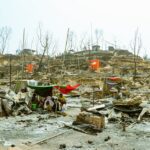
Mount Toba, the supervolcano that nearly wiped out humanity 74,000 years ago, is stirring to life. Indonesian authorities began the largest peacetime evacuation in modern history on January 15, 2026, moving 50 million people from Sumatra as seismic activity reaches unprecedented levels.
The volcano’s caldera, measuring 100 kilometers long and 30 kilometers wide, showed its first significant tremors in December 2025. Ground temperatures have risen 15 degrees Celsius in the past month, while sulfur dioxide emissions increased by 400%. Scientists from the Indonesian Volcanological Survey warn this awakening could dwarf any volcanic event in recorded history.

## The Scale of Indonesia’s Evacuation Challenge
Indonesia faces logistical obstacles that make previous disaster responses look simple. The government activated its National Disaster Management Protocol Level 5 – reserved for existential threats – mobilizing every branch of military and civilian emergency services.
Transportation networks buckle under the pressure. Medan’s Polonia Airport processes 200,000 evacuees daily, ten times its normal capacity. The government chartered 500 commercial aircraft and deployed 50 military transport planes in continuous rotation. Maritime evacuation proceeds through Belawan Port, where 100 vessels ferry people to Java and Kalimantan.
President Joko Widodo established 15 evacuation zones, each managed by dedicated task forces. Zone commanders report directly to Jakarta every six hours. The military converted 200 schools and government buildings into temporary shelters, each equipped with medical stations and communication centers.
Supply chain disruptions compound the crisis. Rice prices jumped 300% in affected areas before price controls took effect. The government releases strategic reserves while coordinating with Malaysia and Singapore for emergency food imports.
## International Response and Scientific Monitoring
The global scientific community mobilizes unprecedented resources to monitor Toba. NASA redirects three satellites to provide continuous thermal imaging, while the European Space Agency shares real-time ground deformation data. Japan deploys its most advanced seismographic equipment, capable of detecting micro-tremors from 2,000 kilometers away.

The United States Pacific Fleet positions the USS Ronald Reagan carrier group in the Malacca Strait, ready for humanitarian operations. Australia pledges AUD $500 million in emergency aid and opens immigration fast-tracks for Indonesian refugees. Singapore converts Changi Airport’s Terminal 5 construction site into a massive refugee processing center.
Dr. Emily Richardson from the Smithsonian’s Global Volcanism Program leads an international monitoring team. Her equipment detects magma movement 15 kilometers below the surface – the deepest volcanic activity ever recorded. “We’re witnessing geological processes that occur once every 100,000 years,” Richardson explains. “The magma chamber contains enough material to bury Southeast Asia under meters of ash.”
China commits 20 cargo aircraft for daily supply runs, while India offers temporary resettlement for 100,000 people. The European Union activates its Emergency Response Coordination Centre, coordinating aid from 27 member nations.
## Economic and Global Implications
Toba’s awakening triggers worldwide market volatility. Palm oil futures spike 200% as Indonesia supplies 60% of global production. Semiconductor manufacturing faces disruption since Indonesia produces critical rare earth minerals. Samsung and Apple emergency-source materials from alternative suppliers, driving tech stock prices down 15%.
Global shipping routes require immediate restructuring. The Malacca Strait, handling 25% of world trade, could close within hours if volcanic activity intensifies. Major shipping companies reroute cargo through the Lombok Strait, adding 1,000 kilometers and five days to journey times.

Insurance companies face potential claims exceeding $2 trillion. Lloyd’s of London activates catastrophe protocols while reinsurance markets prepare for the largest payout in history. Currency markets show extreme volatility as investors flee to safe havens, pushing gold prices to record highs.
Agricultural impacts extend beyond Indonesia. Climate models predict volcanic ash could reduce global temperatures by 1-3 degrees Celsius if Toba erupts fully. The 1815 Tambora eruption caused the “Year Without a Summer,” triggering famines across Europe and North America. Toba’s potential impact dwarfs Tambora by orders of magnitude.
## Technological Solutions and Modern Preparedness
Unlike the last Toba eruption, humanity now possesses advanced warning systems and response capabilities. Indonesia’s disaster management integrates artificial intelligence to optimize evacuation routes in real-time. AI algorithms process satellite data, traffic patterns, and population density to direct people through the safest, fastest paths.
Communication systems prove crucial. The government launches emergency cell towers powered by portable generators, ensuring connectivity in remote areas. WhatsApp and Telegram partner with Indonesian authorities to broadcast multilingual evacuation instructions. Social media platforms implement special protocols to prevent misinformation spread.
Modern construction standards help building resilience. Structures built after 2010 follow enhanced seismic codes, better withstanding volcanic tremors. Emergency supply caches, established after the 2004 tsunami, provide 72-hour survival kits for displaced populations.
International coordination occurs through the UN’s Disaster Risk Reduction framework. Real-time data sharing between 50 countries enables rapid response deployment. Satellite internet constellations maintain communications even if terrestrial networks fail.
## Long-term Consequences and Preparation
The Toba situation represents a new era of global disaster preparedness. Even if volcanic activity subsides without major eruption, the evacuation effort reshapes emergency response protocols worldwide. Indonesia’s experience becomes a template for managing large-scale population movements under extreme time pressure.
Regional power dynamics shift as Southeast Asian nations strengthen cooperation agreements. ASEAN activates mutual assistance protocols, demonstrating collective response capabilities that extend beyond natural disasters.
The international community must prepare for potential climate disruption lasting months or years. Agricultural sectors worldwide develop contingency plans for reduced sunlight and lower temperatures. Governments stockpile strategic reserves while food scientists accelerate research into climate-resistant crops.
Mount Toba’s awakening serves as humanity’s ultimate preparedness test. The success of Indonesia’s massive evacuation effort depends on international cooperation, technological innovation, and the resilience of 50 million people facing an uncertain future. Whether this ancient giant returns to sleep or unleashes its full fury, the world watches and learns from this unprecedented challenge to human civilization.