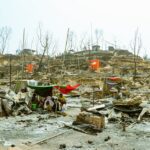
A catastrophic explosion at SolarMax Industries’ flagship manufacturing facility in Phoenix has claimed 47 lives and injured 138 workers, marking the deadliest industrial accident in Arizona’s history. The blast, which occurred at 7:23 AM during the morning shift change, has sent shockwaves through the renewable energy sector and prompted immediate calls for enhanced safety regulations.
Emergency responders described a scene of devastation as the facility’s lithium battery storage warehouse erupted in flames, creating a chain reaction that destroyed three adjacent production buildings. The explosion registered 2.1 on the Richter scale and was felt 15 miles away in downtown Phoenix.

Investigation Reveals Critical Safety Failures
Preliminary findings from the Occupational Safety and Health Administration (OSHA) point to a perfect storm of safety violations at the 2.3 million square foot facility. Investigators discovered that SolarMax had stored over 50,000 lithium-ion battery cells in a warehouse originally designed for standard solar panel components, exceeding fire safety capacity by 400%.
The company’s internal documents, obtained through emergency search warrants, reveal that facility managers ignored three separate safety warnings from their own engineers over the past eight months. Chief among these concerns was inadequate ventilation in battery storage areas and the absence of specialized fire suppression systems designed for lithium fires.
“This wasn’t an accident—it was negligence on a massive scale,” said Maria Rodriguez, OSHA’s Southwest Regional Administrator. “We found critical safety protocols that were either ignored or never implemented despite repeated warnings from the company’s own safety team.”
The explosion originated in Building C, where workers were processing defective battery cells returned from solar installation sites. Security footage shows a small fire beginning near a damaged lithium battery around 7:20 AM, which quickly spread to adjacent storage racks containing thousands of similar units. Within three minutes, the thermal runaway effect—a chain reaction where overheated batteries cause neighboring cells to ignite—had engulfed the entire 400,000 square foot warehouse.
Congressional Response Accelerates
House Energy and Commerce Committee Chairman Robert Chen (D-CA) announced emergency hearings beginning next week, with SolarMax CEO David Patterson and Department of Energy officials scheduled to testify. The investigation will examine whether federal renewable energy incentives inadvertently prioritized rapid expansion over worker safety.
“We’ve thrown billions in subsidies at this industry without ensuring basic protections for the people building our clean energy future,” Chen stated during a press conference Tuesday. “This tragedy demands immediate action, not just thoughts and prayers.”
Senator Patricia Wells (R-TX), ranking member of the Senate Energy Committee, has called for a moratorium on new federal renewable energy projects until comprehensive safety standards are established. Her proposal includes mandatory third-party safety audits and $500 million in additional funding for OSHA renewable energy inspections.

Industry-Wide Safety Concerns Surface
The Arizona disaster has exposed systematic safety gaps across the rapidly expanding renewable energy manufacturing sector. Federal data shows that workplace injuries in solar panel manufacturing increased 340% between 2022 and 2025, far outpacing traditional manufacturing sectors.
Similar facilities operated by competitors including GreenTech Manufacturing, Apex Solar Systems, and Renewable Components Inc. have reported 127 serious safety violations since 2024, according to OSHA records obtained by NewsInformer. These violations include improper chemical storage, inadequate fire suppression systems, and insufficient worker training on hazardous materials handling.
The Solar Industries Association, representing 89% of U.S. solar manufacturers, acknowledged the need for enhanced safety protocols in a statement released Wednesday. “While we deeply mourn the lives lost in Arizona, we recognize this tragedy as a wake-up call for our entire industry,” said Association President Jennifer Huang.
However, internal industry communications suggest that safety improvements have been repeatedly delayed due to competitive pressure and federal production deadlines tied to clean energy tax credits. Companies receiving federal subsidies under the Inflation Reduction Act must meet aggressive production targets to maintain their funding, creating what safety experts describe as a “race to the bottom” mentality.
Economic and Legal Ramifications
SolarMax Industries’ stock price plummeted 67% in pre-market trading, wiping out $8.3 billion in market value. The company faces potential criminal charges and civil lawsuits that could exceed $2 billion, according to legal experts familiar with industrial accident litigation.
The facility employed 3,200 workers and produced approximately 15% of Arizona’s solar panel manufacturing capacity. Its closure will likely delay completion of major solar projects across the Southwest, including a $4.7 billion installation serving Las Vegas and a critical grid modernization project for California utilities.
Insurance industry analysts estimate total claims related to the explosion could reach $1.8 billion, making it the costliest renewable energy industrial accident in U.S. history. Lloyd’s of London and Munich Re, primary insurers for the facility, have already dispatched teams to Phoenix to assess damages and begin the claims process.
Immediate Safety Reforms and Future Outlook
Federal regulators have announced emergency safety inspections at all 47 major solar manufacturing facilities nationwide, focusing on lithium battery handling and storage protocols. These inspections, scheduled to complete by February 15, 2026, will determine which facilities can continue operating during the investigation.
The Department of Energy has suspended $2.1 billion in planned grants to solar manufacturers pending the development of enhanced safety standards. New requirements under consideration include mandatory fire suppression systems specifically designed for lithium fires, real-time air quality monitoring, and quarterly third-party safety audits.
Worker advocacy groups are pushing for even stronger measures, including criminal liability for executives whose companies violate safety protocols and mandatory safety training requirements for all renewable energy workers. The United Solar Workers Union has called for a 30% increase in safety inspector positions at OSHA to handle the industry’s rapid growth.
The tragedy in Arizona represents a critical inflection point for America’s renewable energy ambitions. While the push toward clean energy remains essential for climate goals, the deaths of 47 workers underscore the urgent need for safety standards that match the industry’s rapid expansion. Congressional investigations over the coming months will determine whether federal renewable energy policy can successfully balance environmental goals with worker protection, or if the rush toward clean energy has compromised the fundamental obligation to keep workers safe.